Harrakan Heartlands
The Calamitous BobThe Harrakan Heartlands are the ruined western interior of Param and the geographic heart of the Old Empire’s former power. They matter decisively because Viviane Saint-Lys’s early survival, training, alliance with Solfis, and eventual movement toward the living world all take place against this immense landscape of magical devastation, undead persistence, and imperial remnants.
Definition and Historical Setting
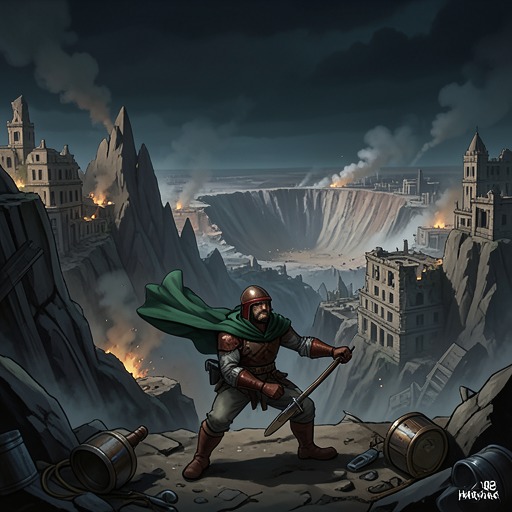
The Harrakan Heartlands occupy the western part of Param, a large circular continent linked to its only neighbor by an isthmus no broader than a city. The region bears the physical stigma of the greatest magical catastrophe ever recorded. From above, the scar resembles necrotic tissue on an otherwise healthy body: a vast valley enclosed by snow-capped mountain ranges, with only a small opening to the south. Its center is darkest, while shrubs and enduring plants gradually return farther from the epicenter.
The catastrophe is inseparable from the Old Empire’s history. The empire once made the region its seat of power, terrifying the wider world while its elites reached unprecedented heights of magical ability. Their attempt to wield that power produced their own destruction, leaving the empire to die at the apex of its strength. Its legacy survives only in private collections and in the languages of kings; across the Heartlands themselves, the remaining inhabitants are mindless undead.
The Ruined Imperial Core
At the heart of the region stands a dead imperial city extending for kilometers with the exacting geometry of rigorous urban planning. Estates, temples, churches, and squares remain darkened and empty, while basaltic sand stretches toward distant mountains. Rubble as large as apartment buildings lies scattered across the plain, suggesting destruction on a scale far beyond an ordinary military bombardment.
The Imperial Ziggurat makes the devastation especially legible. Viviane Saint-Lys stands near the summit of a pyramid whose enormous obsidian steps diminish into the distance, flanked by statues four men high. The summit has been destroyed by a gigantic crater with molten, ragged edges of vitrified stone, an impact more comparable to an asteroid strike or a tactical nuclear warhead than to conventional weaponry. The architecture therefore functions as both monument and evidence: the Heartlands preserve the grandeur of the Old Empire, but their most imposing structure also records the violence that ended it.
The region is not merely abandoned. Its sandy corpse is still crossed by mindless undead, making the imperial ruins an active danger rather than a static archaeological site. Viviane Saint-Lys recognizes that survival requires departure, not shelter. Buildings provide cover from monsters, but the surrounding land offers no reliable source of food or water, and the absence of rain makes prolonged habitation impossible.
Survival and the Southern Route
The Heartlands become Viviane Saint-Lys’s first major environment after her arrival on Niyl. She understands that the squad depends on her even though the world is not her own, and her immediate objective becomes escape. Solfis guides her through the devastated region while helping her turn an impossible displacement into a practical survival plan.
Her route is shaped by the geography of the Heartlands. A western passage would lead toward an ocean, while the western mountains offer little else, so Solfis directs her south toward the gap separating the Harrakan Heartlands from the rest of the continent. The alternative would require climbing a mountain and crossing a centuries-old, unlit tunnel whose condition is unknown. Walking toward a forest appears safer, especially because Viviane Saint-Lys wants to reach other people and to monitor the possibility that the dead monsters of the region might migrate toward her future kingdom.
The journey also turns the Heartlands into a training ground. With Solfis’s assistance, Viviane Saint-Lys practices magic, reaches the third rank of the hedge witch path, improves her mana manipulation and meditative trance, and completes the Sneak, the black cloak. She learns to charge and reliably fire a powerful bolt at ten paces, repeating the attack after several seconds. The landscape’s danger thus produces a cycle of movement and adaptation: the Heartlands threaten her with monsters and deprivation, while the time spent escaping them develops the abilities required for later survival.
Boundaries, Mana, and Living Lands
Near the southern gap, the Heartlands reveal a sharp ecological and magical threshold. From a small plateau, Viviane Saint-Lys can see flat plains, the openings in the mountain range, and hints of salvation. Beyond the gaps, the world is green; a dense forest is plainly alive, in stark contrast to the blackened plains behind her. Dark shrubbery marks the gradual fading of black mana, but zombies still dot the landscape.
The region’s magical condition is sustained by its inhabitants. Cernit explains that the Deadlands have reached an equilibrium in which the many undead monsters create a black field of their own. Reducing that field would require several large-scale expeditions to kill enough of them, and no kingdom considers the land worth the resources because recovery would take decades while easier territories remain available for development. The Heartlands therefore persist as a self-reinforcing frontier: the catastrophe created undead, the undead maintain the black mana, and the continuing saturation discourages states from attempting reclamation.
The contrast becomes even clearer when Viviane Saint-Lys finally reaches free land near Kazar. After twenty minutes, she encounters grass, loam, sap, and ordinary deciduous trees, while Kazar rises in the distance from vibrant green toward gray at the top of its hill and the sky beyond remains dark and menacing. The scene does not erase the Heartlands; it defines the living world by placing it immediately beside the dead one.
Regional and Political Significance
The Harrakan Heartlands are not an isolated wasteland but the central dead zone in a larger continental network. A tattered map shows the region at the western end of Param, separated from Baran by several countries, with the Harrakan Heartlands marked by a small skull. Baran lies in the far east of the continent, and Kazar belongs to Enoria, a former major power that split in two fifteen years earlier after a failed coup and a two-year civil war.
This geography explains why the Heartlands influence politics far beyond their borders. They separate kingdoms, constrain travel, and preserve the remains of a vanished imperial order. Their undead population is large enough to sustain the black field but not valuable enough, in the eyes of surrounding kingdoms, to justify a prolonged reconquest. The region is consequently both a historical center and a political margin: once the seat of an empire that terrified the world, it has become land that neighboring powers leave to its monsters.
The Heartlands also expose the fractured social world surrounding the ruins. The Kark are undergoing severe hardships, and many northern free cities have formed the Pure League, while Enoria bears the consequences of its own civil conflict. Against that unstable continental background, the Heartlands stand as the oldest and most extreme example of collapse: a power that destroyed itself so completely that even its center survives only as architecture, black mana, and undead repetition.
Narrative Function
As a setting, the Harrakan Heartlands combine imperial ruin, ecological threshold, and initiation ordeal. Viviane Saint-Lys enters a world where the landscape itself is evidence of past magical ambition, and she must read that evidence practically: there is no rain, no renewable food, no safe permanence, and no reason to assume that the undead will remain contained. Her escape southward is therefore not simply a change of scenery but the first movement from death toward society.
The region’s most important contrast is between monumental civilization and biological absence. Planned cities, temples, churches, colossal statues, and the cratered Imperial Ziggurat testify to an advanced culture; the empty streets and mindless undead show what remains when power loses the capacity to sustain life. The green forest beyond the southern gap provides the first visible promise that the world is larger than the catastrophe. By forcing Viviane Saint-Lys to cross this boundary, the Harrakan Heartlands establish the book’s recurring tension between inherited destruction and the possibility of rebuilding.